AI Brand Reputation: What AI Engines Say About Belgian Supermarkets




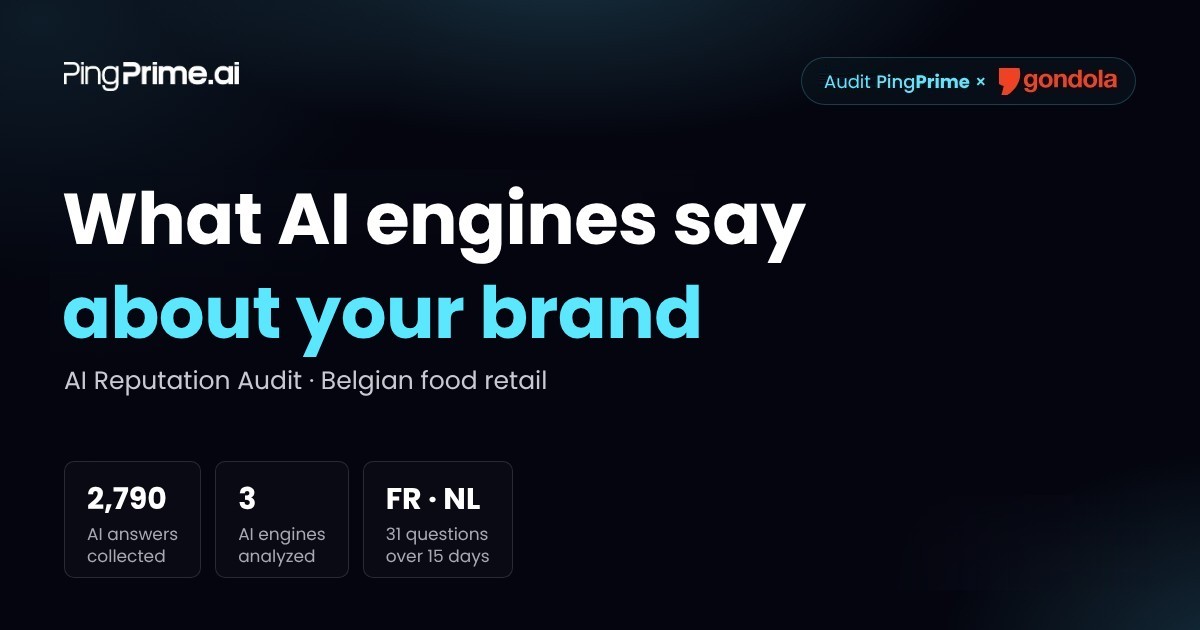
TL;DR. For Gondola, the reference media of Belgian retail and FMCG, PingPrime audited how AI engines talk about Belgian supermarkets: 31 shopper questions, asked daily from 25 September to 9 October 2026 to ChatGPT, Google AI Overview and Google AI Mode, in French and Dutch. 2,790 AI answers, 15,368 cited links. What they show: Delhaize dominates the conversation but concentrates the sector's most recurrent and consistent criticism; Colruyt is the recommendation champion, yet some product verdicts escape it; Bio-Planet, three times less visible than the leaders, out-collects Carrefour on recommendations. And none of it stands still: one AI reading in five changed position within 15 days, almost always after a third-party publication. Gondola's special dossier tells the sector story; this article unpacks what it means for any brand.
The full report is free to download: Rapport sectoriel (FR) · Sectorrapport (NL).
On 6 October 2026, an NGO published its Superlist ranking of Belgian supermarkets' environmental performance. Within 72 hours, ChatGPT, Google AI Overview and Google AI Mode had all absorbed it, in both national languages. Lidl became the engines' sustainability reference. Aldi inherited the last place. Nobody at either retailer had published anything.
We know this because we were watching, every day, question by question. What I observe in individual AI reputation audits, we measured here at sector scale, for a media partner that knows Belgian retail better than anyone: Gondola.
Why Gondola put AI answers on its cover
Gondola dedicates a special dossier to this audit: the first sector-wide photograph of what AI engines tell Belgian shoppers about their supermarkets. The question behind it is the one every retail CEO should be asking. When a consumer asks an AI which store to trust, which loyalty card disappoints, where promotions are real bargains, who does the engine recommend, and based on what?
The protocol, built by PingPrime: 31 consumer questions covering loyalty, prices, freshness, staff, sustainability and more, asked every day from 25 September to 9 October 2026, in mirrored French and Dutch versions, to three engines: ChatGPT, Google AI Overview and Google AI Mode. The corpus: 2,790 AI answers and 15,368 cited links, with no missing day (PingPrime × Gondola, 2026).
One note on method, because it matters: the findings below, favorable or critical, are what the engines answered during that window. They are the engines' readings, not PingPrime's judgment, and not Gondola's. And 15 days photograph a reliable tendency on this sample, not a representative survey.
The Delhaize paradox: being known is not a net asset
Delhaize is the retailer the engines talk about most: named in 89% of French-language answers and 84% of Dutch-language ones (PingPrime × Gondola, 2026). It is also the most contested. Question after question, the same criticisms return until they form a consistent counter-narrative, repeated from question to question: the SuperPlus loyalty card is the first card the engines name as disappointing, in both languages, extended by self-scan friction on the French side and by price perception on the Dutch side.
Yet the same Delhaize takes the engines' first place on bread and on wine, and co-leads on freshness in Dutch. Both stories are true at once. That is the point: at this level of visibility, the question is no longer "do they talk about us?" but "what story do they tell?". Awareness is not an asset you own; it is a narrative someone is writing. The study shows who.
Recommendation has its own logic: the Colruyt case
Gondola's dossier calls them "positive verdicts", and the audit is careful to count two levels separately. The explicit recommendation: the engine names a retailer as a good choice, and one answer can contain several. The verdict: the first place, the retailer designated as THE choice of a question or a territory. A brand can stack recommendations without ever taking a verdict. On French-language wine, Colruyt is recommended, but the verdict belongs to Delhaize.
On recommendations, Colruyt dominates both languages over the full period, with 27 explicit recommendations in French and 21 in Dutch, driven notably by price, promotions, trust, staff and meat (PingPrime × Gondola, 2026). Local producers, where the brand is both recommended and criticized, are a double-edged territory.
On product quality, the picture is more contrasted. Freshness and bakery: the Colruyt brand itself does not take the first place; those verdicts go to Bio-Planet (freshness, on the French side) and CRU (bakery, on the Dutch side, on one engine), the group's own specialist banners, alongside Delhaize and Lidl. Wine: recommended in second position behind Delhaize on the French side, and sharing the first place with Delhaize on the Dutch side. Meat: first in both languages, under its own brand.
For AI engines, each banner carries its own authority: a multi-banner architecture fragments the group's reputational capital.
The sharpest proof that visibility does not buy recommendation sits in one comparison. Bio-Planet appears in only 27% of French-language answers and collects 14 explicit recommendations. Carrefour appears in 82% and collects 12. A narrow territory with net proof beats presence on every front. The engines reason in comparative landscapes, naming five retailers per answer on average, and they reward the brand with a distinct role in that landscape.
Who actually writes the sector's AI reputation: about ten sources
The retailers' own websites are massively cited in the corpus, but mostly for facts and proof: addresses, promotions, assortments. The moment a question invites judgment, the engines switch to third parties. And that third-party layer is strikingly concentrated: around 500 domains are cited per market, yet the top 10 concentrates roughly 40% of all citations (PingPrime × Gondola, 2026).
The two languages have two cultures of proof. On the French side, the top source is the consumer comparator test-achats.be (8.6% of all citations alone), and three of the top ten are community platforms: Facebook, YouTube, Reddit. Judgment forms through tests and lived experience. On the Dutch side, five of the top ten are news media, led by hln.be (7.4%): the story runs through the press, including the agricultural press, which makes the farmers' narrative structural in Flanders, not episodic.
This is the quantified version of what we call working both sides of the signal. On-site, because one well-built page can carry an entire territory in the answers. Off-site, because being well treated by ten pivot sources weighs more than being visible on a hundred sites.
Read that sentence carefully, because it is not only about volume. The engines do like repetition: a story gains weight when independent sources repeat it. But repetition alone does not decide; trust, authority and coherence do. Three properties make a source weigh in an AI answer. Its authority: who is speaking, and does the engine already treat it as a reference for the category. The coherence of the story: do independent sources describe you in the same terms, or does each tell a slightly different version? And the readability of the proof: can the engine extract a clear, attributable fact without friction? Ten trusted sources that corroborate each other build a position. A hundred scattered mentions that diverge dilute it.
Lidl is the living demonstration: its trust, freshness and sustainability positions in Dutch are carried by YouGov, the Versrapport and the Superlist, three independent references the engines already treat as authorities, not by lidl.be.
Fifteen days, 38 reshuffles: AI reputation is a flow
This may be the dossier's most important result. Of the 186 engine readings we tracked between 25 September and 9 October 2026, 38 changed position: a new retailer on top, or a tone that flipped. One in five (PingPrime × Gondola, 2026). The trigger is almost systematic: a freshly indexed third-party publication.
The stories behind the numbers are worth telling:
- The Superlist, 72 hours. The sustainability conversation was vague until 6 October. Then the NGO ranking was absorbed by all three engines in three days, in both languages. Lidl first, Aldi last.
- Carrefour's self-scan redemption. From "bad pupil" on checkout friction to recommendation number one on Google AI Overview in Dutch, in about a week. A territory of irritants can flip in days.
- The rotating culprit. The retailer blamed for price increases changed twice during the window, following each newly indexed price survey: first Colruyt, then Carrefour and the proximity formats, then Albert Heijn.
- The AI sommelier. Colruyt launched an AI wine advisor on 1 October; Google AI Mode was citing it in the Dutch wine answers from launch. One of the rare drifts plausibly triggered by a retailer's own move rather than a third party's.
Add one more layer of instability: the engines disagree with each other. Where at least two engines designate a first choice, they are unanimous only 44% of the time, because each has its own source diet: ChatGPT leans on e-commerce and comparators, Google's tools (AI Overview and AI Mode) on the press. You can win one engine and lose the other two.
Without a calendar of fresh proof, others write your story.
Two languages, two conversations about the same country
The same 31 questions, asked in French and in Dutch, do not produce the same story. Albert Heijn weighs 19 points more in Dutch-speaking Belgium; Carrefour, 14 points less; Jumbo barely exists outside Flanders (PingPrime × Gondola, 2026). The cause is upstream: each language has its own source ecosystem, and only one media outlet is common to both top 10s: retaildetail.be.
For any brand operating in Belgium, the implication is uncomfortable but actionable: you do not have one AI reputation, you have one per language, and they must be measured and worked separately.
What this means for your brand, in any sector
You do not need to be a supermarket for these mechanics to apply. Five consequences to act on:
- Measure mention, citation and recommendation separately. Delhaize leads mentions, Colruyt leads recommendations, test-achats.be leads citations. A dashboard that tracks only visibility will miss two of the three battles.
- Identify your ten pivot sources, per language. Which domains feed the AI answers about your category, and what do they say about you today? In this sector, the answer fits on one slide and dictates the priorities.
- Choose territories, install proof. Bio-Planet beats Carrefour on recommendations with a third of its presence. The engines reward a precise claim backed by evidence, not noise on every front.
- Prepare for the critical framings. On questions that invite criticism, 42 to 54% of readings are negative or mixed, against 3% on quality questions (PingPrime × Gondola, 2026). Know which framings you lose before shoppers ask them.
- Monitor continuously. A single indexed publication redistributed verdicts in 72 hours. An annual audit photographs a river. Quarterly waves are the minimum cadence we consider serious.
One caution, because nuance is part of the method: this layer of work does not replace SEO or brand strategy. It covers what they do not: how generative engines select, describe and recommend you, language by language, engine by engine.
FAQ
What is an AI reputation audit?
An AI reputation audit measures how generative engines (ChatGPT, Google AI Overview, Google AI Mode and others) describe, criticize and recommend a brand: which questions it appears in, how it is portrayed, and which sources feed those answers. It differs from social listening because it analyzes the engines' own answers and citations, not public conversations.
What does the Gondola special dossier contain?
Gondola's dossier presents the sector results of the PingPrime audit: which Belgian retailers the engines name, cite and recommend, the "positive verdicts" by territory (price, freshness, staff, sustainability and more), and how the answers shifted during the 15-day observation window (25 September to 9 October 2026), in French and in Dutch.
Why do AI answers about brands change so often?
Because engines verify in real time and continuously ingest fresh sources. In this audit, one in five tracked readings changed position within 15 days, almost always after a third-party publication was indexed: the Superlist sustainability ranking reshuffled the verdicts of all three engines in 72 hours.
Does being well known guarantee being recommended by AI engines?
No. Delhaize is named in 89% of French-language answers yet carries the sector's heaviest critical narrative, while Bio-Planet, present in 27% of answers, collects more explicit recommendations than Carrefour, present in 82%. Engines reward a net narrative on a precise territory, not raw visibility.
How can a brand improve how AI engines describe it?
Work both sides of the signal. On-site: structured, educational, retrieval-ready pages that engines can extract as proof. Off-site: a deliberate presence in the pivot sources that engines cite for your category, per language and per engine. Then measure in continuous waves, because positions move weekly.
Sources
- Gondola, special dossier on the AI reputation of Belgian supermarkets, based on the PingPrime audit, November 2026.
- PingPrime × Gondola, "Que disent les IA des supermarchés belges ?", AI reputation audit, sector report, Belgian food retail, November 2026. Collection window: 25/09 to 09/10/2026, 2,790 AI answers, 15,368 cited links. Free report: Rapport sectoriel (FR) · Sectorrapport (NL)
All figures in this article come from the PingPrime × Gondola audit. Quotation is authorized with the mention "PingPrime × Gondola". The findings, favorable or critical, restitute what the AI engines answered during the observation window: they express neither PingPrime's nor Gondola's judgment of the retailers named.
Topic, angle, convictions: mine. AI assists the writing. I make the call.
Sabrina Bulteau is the co-founder of PingPrime.ai, GEO Expert and specialist in Narrative Authority in AI Search. She helps brands, institutions and media become the reference AI engines trust, cite, and repeat. She previously co-founded Be Connect (acquired by iO Group) and Sench, is active within CEC Belgium, and brings 25 years of experience in digital growth and strategic positioning.