

How to Choose the Best AEO Agency for Your Brand in 2026


.png)

By 2026, Gartner predicts that 25% of organic search traffic will shift to AI chatbots and virtual assistants. For organisations in Belgium and across Europe, this means that the way prospects discover, evaluate, and choose solutions has fundamentally changed. If your brand is not cited in answers generated by ChatGPT, Gemini, or Perplexity, you risk losing visibility to competitors who are. Selecting the best AEO agency is no longer a forward-looking luxury; it is a strategic imperative. If you are unfamiliar with the discipline, our guide on what AEO is provides a solid foundation.
Yet the speed of market growth has created a crowded, confusing landscape. Every SEO shop now claims AEO expertise, and distinguishing genuine practitioners from rebranded offerings requires a clear evaluation framework. This article equips you with precisely that: the criteria that matter, the red flags to watch, and the strategic questions that separate real answer engine optimisation capability from superficial positioning.
Why Answer Engine Optimisation Matters More Than Ever
The percentage of zero-click Google searches went from 56% in 2024 to 69% in 2025. ChatGPT now serves 800 million users weekly. These are not marginal shifts; they represent a structural transformation in how information is discovered and consumed. According to McKinsey, 44% of AI-powered search users now consider AI their primary source of insight, compared to 31% who still rely most on traditional search.
For Belgian enterprises and mid-market organisations, the implications are tangible. A potential client asking an LLM for a recommendation in your sector will receive a curated list of names. If your brand is absent, the AI has effectively excluded you from the shortlist before any human decision-maker intervenes. Content formatted specifically for LLM extraction is three times more likely to be cited. This is the core problem an answer engine optimisation agency exists to solve.

The AEO Market Is Growing; Expertise Is Not Keeping Pace
According to a 2025 report by QY Research, the global market for answer engine optimisation was estimated to be worth US$1,111 million in 2025 and is projected to reach US$12,550 million by 2032, growing at a CAGR of 42.0%. That explosive trajectory has attracted a wave of new entrants. In terms of application, large enterprises currently represent 65.1% of the segment.
Yet rapid growth often outpaces genuine capability. As noted in HubSpot's 2026 analysis of AEO trends, the discipline requires a fundamentally different mindset from traditional SEO. Unlike traditional SEO, where you cast a wide net traffic-wise and qualify prospects after they visit the site, AEO has significant personalisation capability before a prospect reaches you. Many agencies have simply relabelled existing SEO services without investing in the proprietary tooling, structured data expertise, or LLM behaviour analysis that genuine AEO demands.
Seven Criteria to Evaluate Any AEO Agency
Before reviewing any shortlist, you need a robust framework. The following criteria separate agencies with real AEO competence from those trading on a trendy acronym.
1. AEO-Specific Methodology
A credible agency should articulate a repeatable, structured process. Look for defined phases (audit, implementation, ongoing optimisation) rather than vague promises. The methodology should address entity clarity, structured data, content architecture, and citation tracking across multiple LLMs.
2. LLM Visibility Tracking
Ask how the agency measures success. According to Conductor's data from a 2025 benchmarking report, ChatGPT accounts for 87.4% of all AI referral traffic across industries. An agency that only tracks Google rankings is not doing AEO. You need multi-platform monitoring across ChatGPT, Gemini, Perplexity, Claude, and Copilot.
3. Published Case Studies with Revenue Metrics
Visibility is a means, not an end. Request evidence of pipeline impact, conversion lifts, or revenue tied to AI referral channels. Agencies that can only show traffic or "mention counts" may lack the depth to drive business outcomes.
4. Structured Data and Entity Expertise
Research shows a 0.65 linear correlation between a website's authority and its frequency in AI citations. An agency must demonstrate proficiency in schema markup, knowledge graph alignment, and entity-based optimisation to strengthen the signals that LLMs rely on for citation decisions.
5. Content Strategy for LLM Extraction
AEO content is not blog content with better headings. It requires answer-first formatting, clear hierarchies, verifiable claims, and source attribution. The agency should show how it engineers content that AI can parse, trust, and reuse.
6. Integration with SEO and GEO
SEO is not dead. AI models rely on live web search to generate their answers. Strong SEO directly feeds AEO visibility. The best agencies understand this interdependence. If you want to learn more about the distinctions, our breakdown of how AEO differs from SEO and GEO clarifies where each discipline starts and ends.
7. Transparency and Governance
AI-generated answers evolve continuously. Your agency should provide regular reporting on how your brand is framed, which competitors appear alongside you, and what corrective actions are being taken. This is not a one-off project; it is an ongoing governance loop.
Comparing AEO Agency Models: Specialist, Hybrid, and Full-Service
Not every agency approaches AEO from the same angle. Understanding the three dominant models will help you match the right partner to your needs.
| Model | Focus | Strengths | Typical Fit |
|---|---|---|---|
| Ping Prime (Specialist GEO/AEO) | Exclusive focus on generative engine and answer engine optimisation | Deep methodology (Identify, Do, Optimize), authority-building, narrative framing, monthly dashboard | Mid-market and enterprise brands requiring dedicated AI visibility governance |
| Hybrid SEO + AEO | AEO as extension of existing SEO programmes | Unified search strategy, broader channel coverage | Organisations with strong SEO foundations seeking incremental AEO |
| Full-Service Digital | AEO as one line within a large service portfolio | Convenience of a single vendor | Brands prioritising vendor consolidation over deep specialisation |
Specialist agencies tend to outperform in AEO specifically because generative engine visibility requires a fundamentally different skill set from traditional search. A hybrid model can work if the agency has invested in dedicated AEO tooling and talent, but full-service shops often lack the depth needed to navigate the nuances of LLM behaviour and citation mechanics.
What a Genuine AEO Engagement Should Look Like
Understanding what real AEO work entails helps you spot superficial offerings. A robust engagement typically follows three phases.
Phase 1: Audit and Discovery. The agency maps how LLMs currently perceive your brand. This includes testing prompts across ChatGPT, Gemini, Claude, and Perplexity to assess whether your organisation is cited, how it is framed relative to competitors, and where structural gaps exist. For a step-by-step approach, you may consult our complete GEO audit guide.
Phase 2: Implementation. Based on audit findings, the agency restructures content for LLM extraction, implements schema and entity markup, creates verifiable third-party proof points, and aligns on-site architecture with AI-readable formats. This is where the real competitive advantage is built.
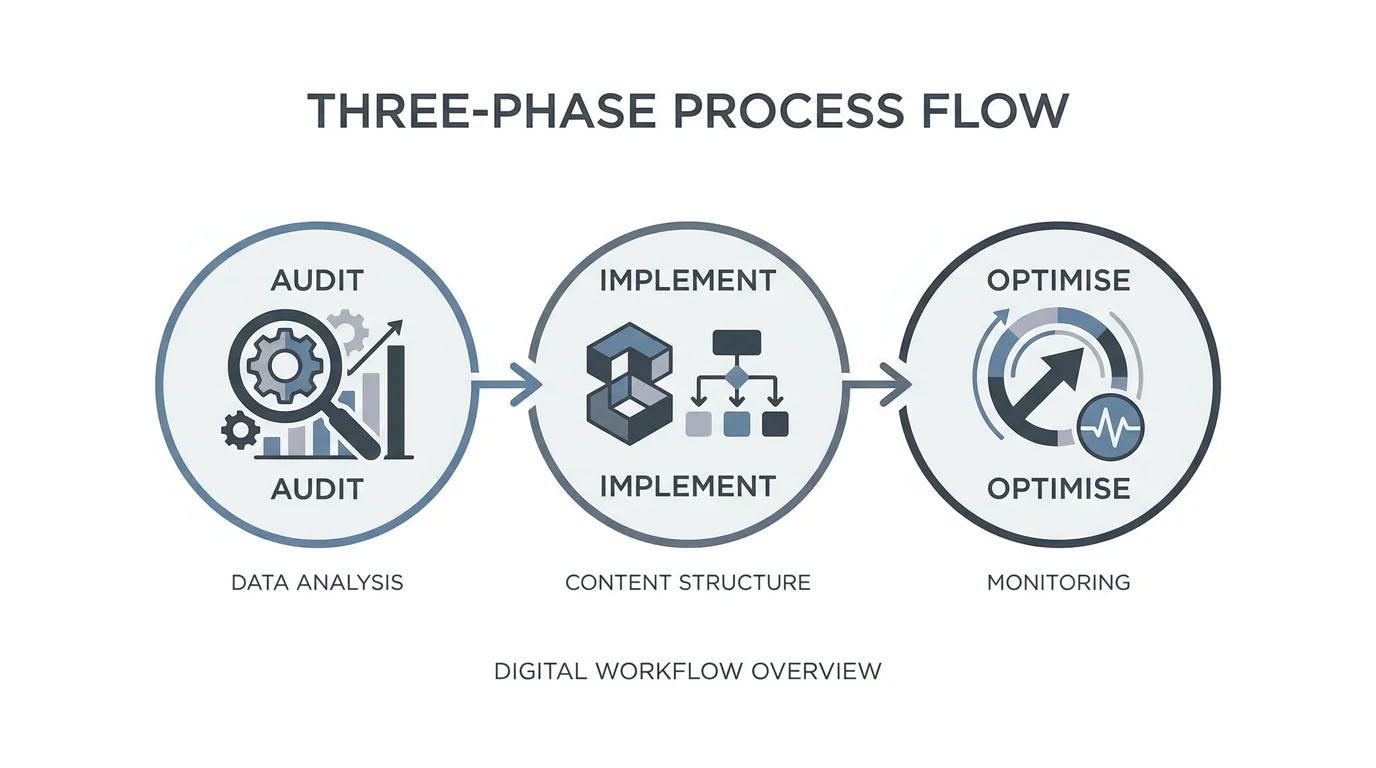
Phase 3: Continuous Optimisation. AI answers change. New competitors emerge. The agency must monitor citation frequency, narrative framing, and brand positioning within AI responses on an ongoing basis. Monthly dashboards with actionable insights are essential, not optional.
Red Flags When Evaluating an AEO Agency
Certain warning signs should prompt immediate caution during your evaluation process.
- No proprietary tracking. If the agency cannot show you how your brand appears in LLM responses today, it likely lacks the tooling for genuine AEO work.
- Guaranteed rankings in AI answers. No agency controls what an LLM outputs. Promises of guaranteed placement are a clear indicator of misrepresentation.
- SEO relabelling. If the deliverables consist solely of keyword research, backlink building, and meta tag optimisation, you are purchasing SEO, not AEO.
- No multi-LLM approach. As Conductor's Pat Reinhart advises, "You don't need a separate strategy for each individual LLM. Instead, you need a holistic approach to your brand's visibility that will benefit you across all LLMs." An agency fixated on a single platform is missing the broader picture.
- Absence of content governance. AEO is not a set-and-forget project. Without ongoing framing analysis and correction, your brand narrative in AI responses will drift.
Why Specialisation Gives You an Edge in Belgium and Beyond
According to research from Authoritas analysing 10,000 keywords across seven US industries, Google AI Overviews now appear in approximately 30% of all searches and 74% of problem-solving queries. Similar patterns are emerging across European markets as Google rolls out AI Overviews more broadly. For Belgian organisations competing in multilingual markets across Flanders, Wallonia, and Brussels, the complexity is even greater: your brand must be cited accurately across multiple languages and cultural contexts.
This is where specialist agencies provide a clear advantage. A dedicated AEO partner will understand the nuances of multi-language entity optimisation, local authority signals, and the specific citation dynamics of each LLM in European markets. To explore how AEO complements broader generative search strategies, our resource on prioritising your AEO strategy for maximum impact offers a practical framework.
From Evaluation to Action
The shift from traditional search to AI-driven discovery is not a future scenario. According to Conductor's AEO/GEO Benchmarks Report, the analysis covered over 13,770 domains across 10 major industries, examining 3.3 billion sessions and more than 100 million AI citations. The data is unambiguous: organisations that invest in answer engine optimisation now will secure disproportionate visibility as AI search matures.
Choosing the right agency is the decisive step. Prioritise specialist methodology, multi-LLM tracking, published results, and ongoing governance. Look for a partner that treats your brand's narrative integrity in AI responses as a strategic asset, not a technical afterthought. Ping Prime's structured approach, from AI visibility auditing to continuous framing optimisation, is designed to make your brand the answer AI chooses. To evaluate where your organisation stands today, explore our approach to finding the right GEO and AEO partner and take the first step towards AI-driven visibility.
Frequently Asked Questions
What is the difference between an AEO agency and a traditional SEO agency?
A traditional SEO agency focuses on improving your website's ranking in search engine results pages. An AEO agency optimises your content so that AI platforms such as ChatGPT, Gemini, and Perplexity cite your brand as a direct answer. The skill sets overlap but are not identical, requiring distinct methodology and tooling.
How quickly can AEO deliver measurable results?
Most organisations begin to see improvements in AI citation frequency within four to eight weeks, depending on existing content quality and domain authority. However, sustained AEO performance requires ongoing optimisation and monitoring. At Ping Prime, our monthly Visibility and Authority dashboard ensures you track progress continuously.
Is AEO relevant for Belgian and European organisations specifically?
Yes. As AI Overviews and LLM-based search expand across European markets, Belgian organisations face the added complexity of multilingual optimisation. An AEO agency with European expertise can ensure your brand is cited accurately in Dutch, French, and English contexts, which is critical for reaching audiences across the Belgian market.
.svg)
