

Why Your Business Needs a GEO Digital Agency in 2026


.png)

Half of all consumers now use AI-powered search, according to HubSpot's 2026 State of Marketing report. For organisations in Belgium and across Europe, this shift means that appearing on page one of Google is no longer enough. If ChatGPT, Gemini, or Perplexity do not mention your brand, a growing share of your audience will never find you. Understanding how to choose the right GEO marketing agency has therefore become a strategic priority.
A GEO digital agency specialises in making your content, data, and authority signals readable, citable, and retrievable by generative AI engines. Unlike a traditional SEO partner, this type of agency focuses on structured data, citation engineering, and continuous AI monitoring. The following sections explain what a GEO digital agency does, why its services matter right now, and how to evaluate the right partner for your organisation.
What a GEO Digital Agency Actually Does
Generative Engine Optimisation (GEO) is the discipline of structuring digital content so it earns citations inside AI-generated answers. If you are unfamiliar with the concept, our resource on what GEO (Generative Engine Optimization) is provides a comprehensive introduction. A dedicated GEO agency translates this discipline into a repeatable service model built around three pillars.
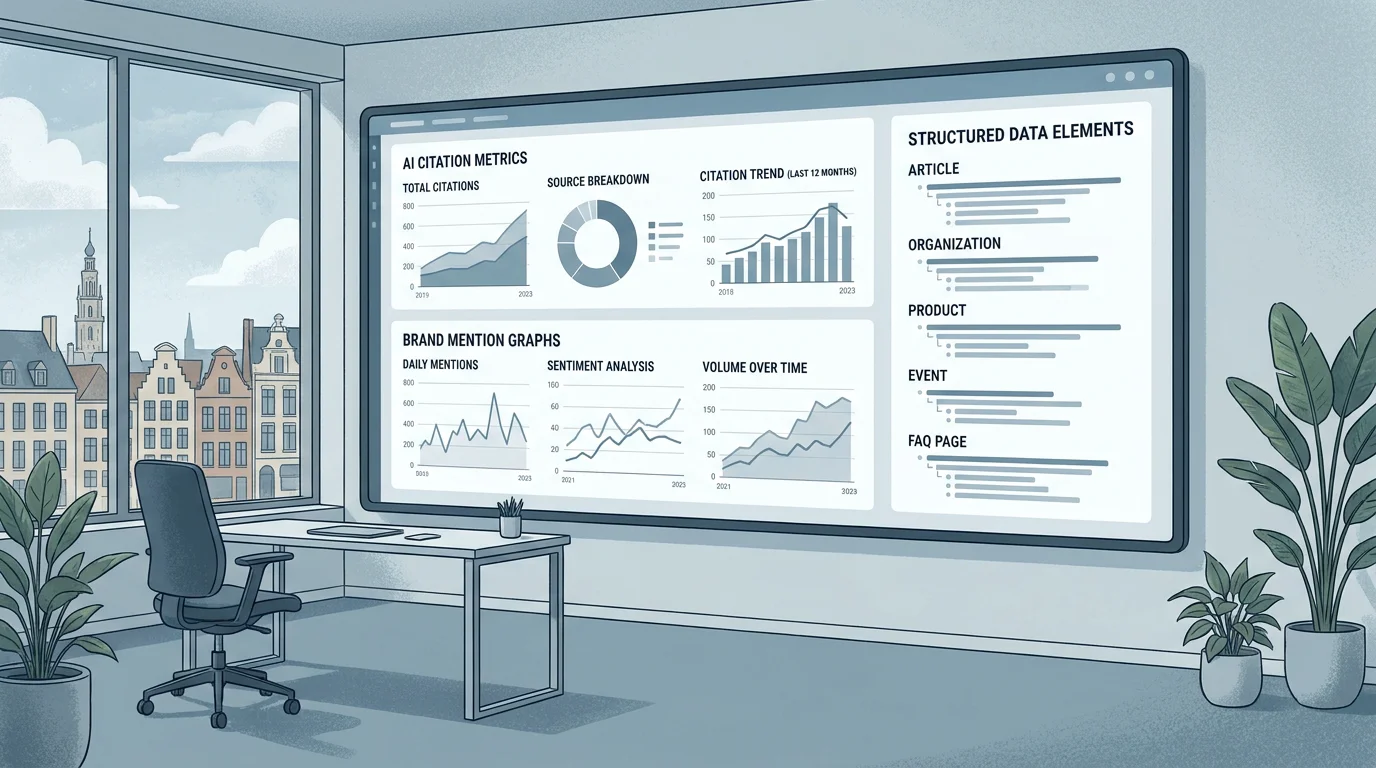
The first pillar is AI visibility auditing. The agency scans generative platforms to determine how often your brand is cited, whether AI engines reference official materials, and how accurately they represent your messaging. New KPIs such as "AI citation share," "overview visibility," and "zero-click displacement rate" have emerged to quantify this performance.
The second pillar is content architecture and citation engineering. Effective GEO relies on extractable, verifiable content: clear claims backed by structured data and authoritative sources to improve citation rates across multi-turn interactions. The agency restructures your pages with schema markup, semantic layering, and knowledge graphs that link key topics, products, and claims.
The third pillar is continuous monitoring and optimisation. A brand without monitoring has no visibility into citations being lost, errors accumulating, or competitors gaining ground in AI-generated answers about their category. A GEO agency tracks these shifts in real time and corrects them before they compound.
Why the Market for GEO Services Is Growing So Fast
The GEO services market is projected to grow from USD 1.48 billion in 2026 to USD 17.02 billion by 2034, exhibiting a CAGR of 45.5% during the forecast period, according to Intel Market Research. Several converging factors explain this acceleration.
ChatGPT reached 900 million weekly active users as of February 2026, up from 400 million in February 2025, according to OpenAI's own reporting. Meanwhile, AI Overviews now trigger on approximately 48% of all tracked queries, a 58% increase year-over-year, according to BrightEdge's one-year AI Overview analysis from February 2026.
The commercial impact is equally striking. AI search traffic is 4.4 times more valuable, converts 3 times better, and is growing at 527% year-over-year. For brands in Belgium competing in multilingual, cross-border markets, the opportunity cost of inaction is considerable.
GEO Versus SEO: Understanding the Core Difference
Traditional SEO aims to rank your page on a search engine results page. GEO aims to make your brand the source an AI engine cites when it synthesises an answer. The distinction is fundamental, and our comparison of how GEO differs from SEO and AEO explores it in full depth.
In practical terms, SEO relies on keyword density, backlinks, and meta tags. GEO relies on structured data, verified citations, and entity context. 83% of AI Overview citations come from pages outside the organic top 10, which means that strong Google rankings alone do not guarantee AI visibility. A page that ranks third on Google may never appear in a generative answer if it lacks the structural signals AI engines need.
Content featuring clear formatting, including hierarchical headings, bullet points, numbered lists, and tables, is 28 to 40% more likely to be cited by large language models. This is why specialised GEO expertise matters. A traditional SEO agency optimises for crawlers; a GEO agency optimises for machine comprehension and source attribution.
The Execution Gap: Why Most Organisations Need Expert Help
92% of marketers plan to optimise for AI search, but only 40.6% are currently doing so. That execution gap, documented in ConvertMate's GEO Benchmark Study 2026, defines the competitive landscape this year.
By early 2026, most enterprise marketing teams have a GEO initiative in place. On the other hand, most SMB marketing teams have not started yet. This disparity creates a compounding first-mover advantage, because citation authority, much like domain authority before it, accumulates over time. Most SMB and mid-market teams have not started, which represents a compounding first-mover advantage given that citation authority accumulates over time.
The measurement challenge compounds the problem. GEO ROI is structurally harder to measure than SEO because zero-click AI answers generate no referral sessions, and shortlist influence happens before any trackable touchpoint. Organisations that lack in-house GEO expertise therefore struggle to build a business case, let alone execute a strategy. A dedicated GEO agency bridges that gap with proven frameworks and the right tracking infrastructure.
What to Look For in a GEO Digital Agency
Not every agency claiming AI optimisation expertise has the methodology to deliver measurable results. When evaluating a partner, consider the following criteria.
- AI visibility scoring: Does the agency measure how often and how accurately your brand appears in ChatGPT, Perplexity, Claude, and Google AI Overviews?
- Structured data capability: Can the team implement schema markup, entity graphs, and semantic layering at scale?
- Citation engineering: Does the agency embed verifiable metadata, canonical links, and reference datasets that AI models can pull from?
- Continuous monitoring: Is there a real-time tracking system to detect citation losses, misattributions, or competitor gains?
- Transparent reporting: Are new KPIs such as AI citation frequency, brand representation accuracy, and AI response share included in monthly dashboards?
At Ping Prime, we built our entire methodology around these principles. Our Identify, Do, Optimise framework covers AI visibility auditing, structured content creation, and ongoing governance. Every month, our clients receive a clear dashboard tracking visibility, authority, and narrative framing across generative engines.

How Content Structure Drives AI Citations
One of the most actionable findings from 2026 research is that content structure matters more than domain authority for generative search. Foundation Marketing found in March 2026 that 68.7% of ChatGPT citations follow logical heading hierarchies (H1 to H2 to H3), and pages with well-structured headings are significantly more parseable by LLMs.
Placement within the page also matters. Growth Memo's 2026 analysis found that 44.2% of all LLM citations come from the first 30% of text (the introduction), 31.1% from the middle section, and 24.7% from the conclusion. A GEO agency uses these insights to front-load key claims, add concise summaries, and structure every page for maximum extractability.
The Princeton GEO framework identified "Statistics Addition" and "Cite Sources" as the top-performing GEO optimisation techniques, boosting visibility by up to 40% in generative engine responses. In other words, content backed by data and linked to authoritative sources is far more likely to earn a citation. Our complete GEO audit guide walks through these structural requirements step by step.
Measuring the Return on GEO Investment
Proving ROI remains the defining challenge in GEO. Users referred from ChatGPT spend an average of 15 minutes on site versus 8 for Google referrals, generate 12 pageviews per visit versus 9, and convert at a 7% rate versus 5% from Google. Across Erlin's client base in 2026, AI traffic converts 3 times better than traditional organic search.
Brands appearing in AI-generated answers experience a 38% click lift and a 39% increase in paid ad clicks. This "citation effect" creates a multiplier on existing marketing investments, which means GEO does not replace your current channels; it amplifies them.
The challenge, however, is attribution. A brand can appear repeatedly inside AI answers, influence perception, and shape decision-making without ever generating a trackable click. This is why specialised tracking frameworks are essential. To explore this topic further, see our analysis of the ROI of GEO in 2026.
Comparing GEO Agency Approaches: A Framework
The GEO agency landscape is still maturing. The GEO market is where SEO was in 2005: early, fragmented, and full of opportunity. When selecting a partner, it helps to compare agencies across consistent criteria.
| Criterion | Ping Prime | Typical Full-Service Agency | Traditional SEO Agency |
|---|---|---|---|
| Exclusive GEO Focus | Yes | Partial (GEO as add-on) | No |
| Structured Methodology (Identify, Do, Optimise) | Yes | Varies | No |
| AI Citation Monitoring | Monthly dashboard | Ad hoc | Not offered |
| Narrative Framing Control | Yes | Rarely | No |
| B2B and Enterprise Experience | 25 years of digital strategy | Varies | Varies |
| Geographic Expertise (Belgium, Europe) | Brussels-based | Varies | Varies |
Leading GEO service providers are establishing repeatable technical approaches focusing on three core areas: indexability controls, structured entity data implementation, and continuous AI model evaluation. The agencies that combine all three with deep industry expertise will deliver the most consistent results. For organisations in Belgium seeking a partner with both local presence and European scope, a Brussels-based web agency offers distinct advantages in understanding multilingual content requirements and regional market nuances.
The Road Ahead: Building Durable AI Visibility
The gap between AI visibility winners and losers is 9 times today and widening at 3.2% every month, according to Erlin's 2026 tracking data across 500 or more brands. Waiting to act does not preserve the status quo; it compounds the disadvantage.
The most effective GEO digital agencies do not treat AI optimisation as a one-off project. They build a continuous loop of auditing, content engineering, monitoring, and correction. The brands that built monitoring into their GEO workflow in 2025 are detecting and correcting errors in two weeks. Those that have not are discovering them, if at all, after two months of compounding damage.
For any organisation whose reputation, revenue, or market position depends on what AI says about it, the question is no longer whether to invest in GEO, but how quickly you can start. With a structured methodology, monthly visibility dashboards, and 25 years of digital strategy expertise, our team helps brands become the answer AI engines choose. To explore whether your content is ready for generative search, request our comprehensive GEO visibility audit and take the first step.
Frequently Asked Questions
What is the difference between a GEO agency and an SEO agency?
An SEO agency optimises your website to rank on search engine results pages. A GEO agency optimises your content, data, and authority signals so that AI platforms such as ChatGPT, Gemini, and Perplexity cite and recommend your brand in their generated answers. At Ping Prime, our exclusive focus on Generative Engine Optimisation means every action is designed around earning AI citations, not just traditional rankings.
How long does it take to see results from GEO?
Initial visibility improvements typically appear within four to eight weeks of implementing structured content and citation engineering changes. However, GEO is a compounding discipline: citation authority builds over time, and continuous monitoring ensures your brand maintains and extends its position as AI models update.
Is GEO relevant for businesses operating in Belgium?
Absolutely. Belgian organisations operate in multilingual, cross-border markets where AI-powered search adoption is rising rapidly. Structured, verifiable content in multiple languages strengthens your citability across generative engines serving Dutch, French, and English-speaking audiences. A locally based GEO partner understands these complexities and can tailor strategies accordingly.
.svg)
