

GEO Is a Brand Channel Disguised as a Performance Channel


.png)
TL;DR
• GEO is sold as a performance lever: fix the markup, open the crawlers, collect the traffic. The data says otherwise. What decides whether ChatGPT, Gemini or Google's AI Overviews cite your brand is not a technical trick. It is brand authority.
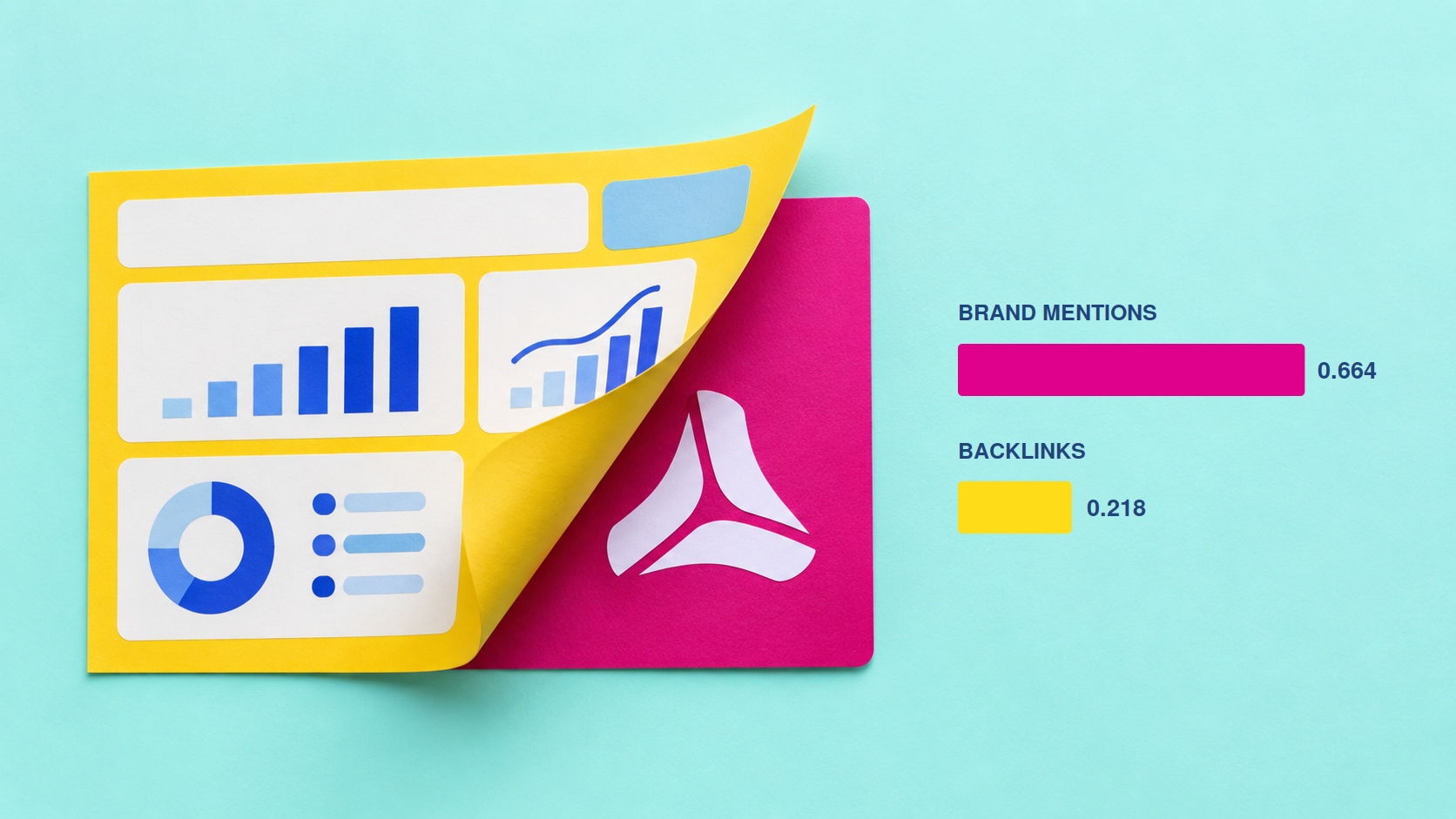
• The numbers converge. Across 75,000 brands, branded web mentions correlate with AI visibility at 0.664, versus 0.218 for backlinks and near zero for publishing volume (Ahrefs, 2025). Classic SEO metrics do not explain who dominates a topic in ChatGPT (Kevin Indig × Semrush data, 1,094 categories, 2026).
• Every branding fundamental has a direct GEO equivalent: positioning becomes entity clarity, coherence becomes the consistency signal, brand story becomes narrative authority, and the owned-earned-paid mix becomes authority transfer.
• The role of technique is precise: it reinforces a signal, it does not create one. Technique opens the door. Branding gets you in.
"A brand channel disguised as a performance channel"
The phrase belongs to Kevin Indig, arguably the most rigorous analyst in the field, in his H1 2026 AI Halftime Report: "AEO/GEO is a brand channel disguised as a performance channel."
At PingPrime, that sentence lands squarely on what we keep repeating to marketing teams. GEO looks like a performance channel because it lives in search interfaces and produces measurable visibility. But the forces that drive it are the ones branding has always worked on: recognition, coherence, reputation. Treat it as a pure performance lever, and you end up optimizing the wrong variables.
The proof that the disguise runs deep sits in the machinery itself. As we showed in our analysis of fan-out queries, engines now write brand names directly into their own background searches: one consistently published firm appeared in ChatGPT's fan-outs 97% of the time across 30 runs of the same category prompt (Seer Interactive, 2026). At that point the brand isn't competing inside the answer. It is the search. No performance tactic produces that. Years of brand building do.
The technical trap: schema, robots.txt and llms.txt are necessary, not sufficient
A large part of the market is chasing the technical hack. Schema markup. The robots.txt file. The llms.txt file. AI crawler access. All of it matters: a brand the bots cannot reach or read starts with a handicap, and the gray market of shortcuts we documented in the rise of GEO's first charlatans shows where hack-first thinking ends.
But technical readiness answers only one question: can the engine read you? It does not answer the one that actually decides visibility: why would the engine choose you?
Necessary. Not sufficient.
How do generative engines recognize a brand?
Generative engines don't just index pages. They recognize entities. When they assemble an answer, they favor the brands they can identify with certainty and describe consistently. That certainty rests on three things:
• A clear entity: the engine knows what the brand is, what it does, and for whom.
• An identical positioning everywhere: the brand says the same thing on its site, its profiles, its content and at its partners.
• A narrative corroborated by third parties: independent sources pick up and confirm the story the brand tells about itself.
In other words: what branding has always built.
From branding to GEO: the four signals the engines read
Every fundamental branding discipline has a direct equivalent in how generative engines evaluate a brand.
Clear positioning → entity clarity
A sharp positioning isn't just a marketing asset. It's what lets the engine classify your brand without ambiguity. If your category, your audience and your differentiation stay fuzzy, the model has nothing solid to attach you to. It will cite someone easier to describe.
Brand coherence → consistency signal
When your description changes between your site, LinkedIn and a directory, you're not just diluting your brand. You're sending contradictory signals. Coherence across every touchpoint turns scattered mentions into a single, recognizable entity.
Brand story → narrative authority
Engines tell stories. The brand whose story is the clearest, the most repeated and the best substantiated becomes the default way of explaining a topic. That is narrative authority: owning the story of your category, not just appearing in it.
Owned, earned, paid mix → authority transfer
Owned media states your narrative. Earned media confirms it. Paid media extends its reach. Together they create the independent corroboration that transfers authority to your brand. A narrative that lives only on your site remains a claim. Picked up by credible third parties, it becomes a fact in the eyes of a model. This is the exact mechanism the buyer-side data revealed in Authority Beats Awareness: models learn category membership from co-occurrence across independent sources, never from what a brand says about itself.
What the numbers say: brand authority outranks domain authority
This is not an intuition. The studies converge, one after another.
Ahrefs: branded mentions, the first predictor of AI Overviews presence
Ahrefs analyzed 75,000 brands (domains with a Domain Rating above 40) and measured which signals predict inclusion in Google's AI Overviews. Branded web mentions came out on top with a Spearman correlation of 0.664. Backlinks, the metric an entire industry built its budgets on: 0.218. Total page count: roughly 0.194, near zero. Publishing volume does not build AI visibility; earned presence does. The December 2025 follow-up extended the analysis to ChatGPT and AI Mode: branded mentions held at 0.656 to 0.709 across surfaces, and YouTube mentions topped everything at roughly 0.737 (Ahrefs, 2025).
Kevin Indig × Semrush data: brand signals drive ChatGPT, SEO metrics don't explain it
In ChatGPT, the same verdict from a different angle. Kevin Indig's analysis of six months of ChatGPT answer data from Semrush, covering 1,094 US categories, 50,000+ brands and 600,000+ citations, found that engines cite brands across many topics but recommend them only where they have built repeated topical authority, and that classic SEO metrics do not explain who dominates a topic (Growth Memo, 2026). The predictor hierarchy backs it up: brand search volume correlates with AI citations at 0.334, ahead of backlinks (Digital Bloom, 680M+ citations, 2025).
Domain authority vs brand authority: why the metrics are splitting apart
Domain authority measures the strength of a site's link profile. Brand authority reflects how widely and consistently a brand is known, mentioned and searched. For years the two moved together. In generative search, they separate: a strong link profile no longer guarantees a model will name you, while a brand people talk about and search for tends to surface, with or without links.
Correlations: Ahrefs, 75,000 brands, 2025.
For marketing teams, the metric that matters shifts from the authority of a domain to the authority of an entity.
The right role for technique: it reinforces a signal, it doesn't create one
None of this makes technique optional. It stays necessary, because it makes the brand reachable and readable for the engines. But its role is precise: it reinforces a signal. It does not create one. A perfect schema on a brand nobody talks about will not make it visible. The same schema on a recognized, consistent brand helps the engines understand it faster and describe it more accurately. The independent data agrees on the hierarchy: schema markup scores 5/10 in business impact for 3/10 in effort, the best technical ratio, but far behind Digital PR (10/10), Guest Posting (10/10) and Reviews (8/10), all off-site levers (NP Digital, 100 marketers, Jan. 2026).
Structured data and entity consistency across platforms
Technique and branding meet on entity consistency. Organization markup, sameAs links to official profiles, and descriptions aligned with public knowledge bases like Wikidata help the engines connect the dots between everywhere your brand appears. But they only work if the underlying narrative is the same everywhere. Structured data must declare a coherent identity, not compensate for an absent one.
What this changes for CMOs and marketing teams
If GEO is a brand channel, it cannot belong to the SEO team alone. Concretely, five moves:
1. Start from the canonical sentence. Define one clear sentence that says who you are, what you do and for whom. Then use it everywhere, verbatim, in every structured surface.
2. Audit the consistency. Check how your brand is described on your site, your social profiles, directories, partner pages and in the press. Fix the contradictions: each one fragments the entity the engines are trying to recognize.
3. Invest in corroboration. Press, expert bylines, reviews and third-party mentions are now visibility levers, not just reputation assets. This is where the 0.664 correlation lives.
4. Keep the technical base clean. Accessibility, structured data and entity markup remain the floor that lets the signal through.
5. Measure brand presence in AI answers. Track whether and how generative engines cite your brand, not just where your pages rank. As the French launch data showed, rankings and reach have become two separate variables.
Branding is GEO. GEO is branding.
The market is chasing the technical hack. The engines, meanwhile, recognize brands. A clear positioning, a coherent identity, a corroborated narrative and a balanced owned-earned-paid mix: that is what makes a brand citable.
Technique opens the door. Branding gets you in.
That conviction is the core of how we approach GEO and narrative authority at PingPrime. The question worth asking your own team this quarter isn't "is our markup right?"
It's "would a model that has read everything about us know exactly what we are?"
FAQ
What is brand authority in generative search?
The degree to which AI engines can identify a brand with certainty and describe it consistently: a clear entity, identical positioning across touchpoints, and a narrative corroborated by independent sources. It is measured through branded mentions and branded search volume rather than link metrics, and it decides whether engines cite you when assembling an answer.
Is technical GEO still worth doing?
Yes. It makes your brand reachable and readable for AI engines, and it is necessary. But on its own it creates no visibility: it amplifies the existing brand signal. Necessary, not sufficient.
What is the best predictor of presence in Google's AI Overviews?
Branded web mentions: 0.664 correlation across 75,000 brands, versus 0.218 for backlinks and roughly 0.194 for content volume. The December 2025 follow-up found YouTube mentions even stronger, at roughly 0.737 (Ahrefs, 2025).
Do classic SEO metrics explain visibility in ChatGPT?
No. Across 1,094 categories and 600,000+ citations of ChatGPT data, engines recommend brands only where they've built repeated topical authority, and classic SEO metrics don't explain who dominates a topic (Kevin Indig, Growth Memo, 2026). Brand search volume predicts AI citations at 0.334, ahead of backlinks (Digital Bloom, 2025).
What is narrative authority?
A brand's capacity to become the reference story of its category: a clear, consistent narrative, corroborated by third-party sources, that generative engines pick up and repeat when they answer. Owning the story of your category, not just appearing in it.
-----
How this was written: Topic, angle, convictions: mine. AI assists the writing. I make the call.
Sabrina Bulteau is the founder of PingPrime.ai, GEO Expert and specialist in Narrative Authority in AI Search. She helps brands, institutions and media become the reference AI engines trust, cite, and repeat, not just one option among many, by working both sides of the signal: on-site (structure, narratives, architecture) and off-site (earned media, platforms, co-citations, sector press). Co-founder of Be Connect (acquired by iO Group) and Sench, active within CEC Belgium, she brings 25 years of experience in digital growth and strategic positioning.



.svg)
