

The Role of Digital PR in GEO: How to Win AI Mentions
.webp)


.png)

Digital PR is no longer just a brand-awareness tool: it has become the #1 lever for GEO (Generative Engine Optimization). Where links used to be the fuel of SEO, today it's brand mentions on authoritative third-party sources that decide whether ChatGPT, Perplexity, Claude, or Google AI Overviews will cite your brand or pass over it in silence.
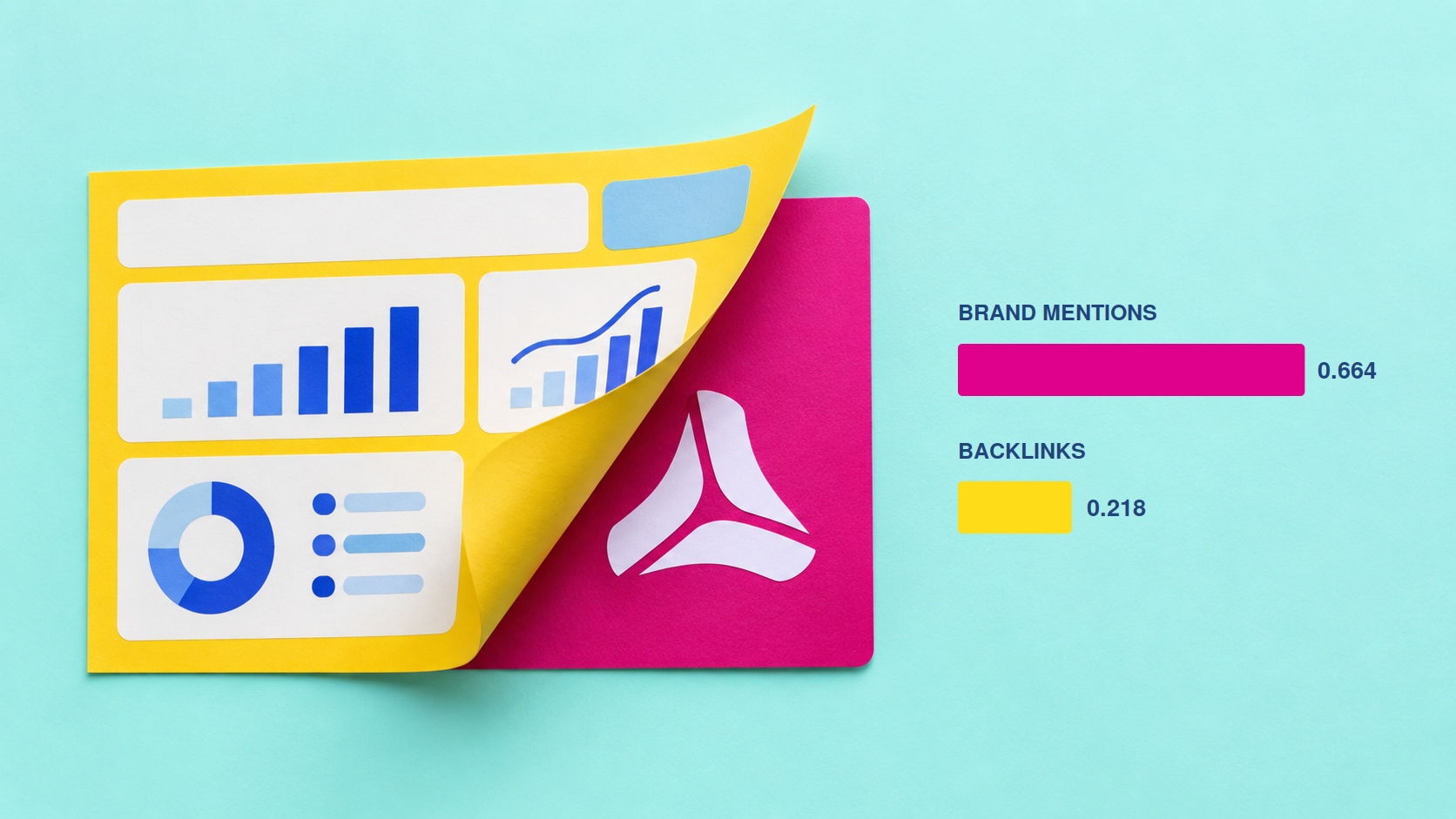
The AirOps study published in 2025 quantified this shift: brand search volume is the single best predictor of AI citations, with a correlation of 0.334, and adding citations to a piece of content boosts its visibility by +37% (AirOps, 2025). In other words, what people say about your brand outside your site now carries more weight than what your site itself says. This guide explains why, which sources to target, and how to build a Digital PR program that produces measurable AI mentions.
The bottom line
- Brand search volume is the single best predictor of AI citations (correlation 0.334) according to AirOps, 2025. Digital PR is what generates it.
- Winning combination: being both mentioned + cited = +40% odds of reappearing from one AI run to the next.
- The sources LLMs actually consult: Wikipedia (47.9% for ChatGPT), Reddit (#1 across all platforms), established tier 1 media, very recent content.
- A data-driven study (barometer, sector survey) remains the highest-ROI Digital PR format for generating editorial pickups and lasting AI citations.
Why is Digital PR the #1 GEO lever in 2026?
The answer fits in one figure. Brand search volume is the single best predictor of citations in AI responses, with a correlation of 0.334 in the AirOps study run across thousands of queries (AirOps, 2025). And this brand search volume is precisely what Digital PR pickups build over time, not technical SEO.
The study goes further. When a brand is both mentioned and cited by LLMs, it has +40% odds of reappearing from one run to the next, versus a simple mention. And adding a third-party citation to a piece of content boosts its AI visibility by +37%, the most powerful lever identified to date. Digital PR ticks all three boxes: it generates mentions, citations, and authority signals on third-party sources.
The other reason is sociological. LLMs were pre-trained on corpora dominated by community and editorial sites: Reddit is the #1 source across all AI platforms combined, with about 40% of citations (Discovered Labs, 2025). You can't optimize Reddit like a product page. You can, however, be mentioned there. That's exactly what Digital PR does.
Our field observation. Across the 25+ brands we support at PingPrime, those that ran a structured Digital PR program (3 to 5 tier 1 pickups per quarter) see their Share of Model rise from 35 to 60% in 6 months. Those investing only in technical SEO stall at around 10 to 15%. The difference isn't marginal: it's a factor of 4.
To understand how Digital PR is evolving from pure visibility toward the verifiability demanded by AIs, read our analysis Digital PR: from visibility to verifiability in the AI era.
Which sources do LLMs actually consult?
Not all press pickups are created equal for GEO. ChatGPT cites Wikipedia in 47.9% of cases and Perplexity favors Reddit with 46.7% of its citations, according to the comparative analysis published by Discovered Labs in 2025 (Discovered Labs, 2025). Understanding this source-platform mapping is the first strategic decision of a GEO-oriented Digital PR brief.
Here is the map validated by the available studies, for the five major platforms:
- AI platform|Dominant sources|Freshness criteria|Digital PR implication
- ChatGPT (Search)|Wikipedia (47.9%), established media, Q&A sites|Low (pre-trained corpus)|Target Wikipedia pages, tier 1 media, and durable barometers
- Google AI Overviews / AI Mode|Top 10 Google organic, high-authority sites, Reddit, YouTube|Moderate|Couple classic SEO + digital PR on Google-trusted sources
- Perplexity|Reddit (46.7%), recent media, sector blogs|Very high (content <30d cited 3.2x)|Target recent press releases, Reddit AMAs, dated podcasts
- Claude (Anthropic)|Editorial sources, academic content, business press|Moderate|Prioritize Wikipedia, business/tech press, papers and studies
- Gemini / Google AI|Google index, YouTube, Reddit, Wikipedia|Moderate|Native Google strategy, video, and Wikipedia presence
The takeaway: a pickup in Le Soir or L'Echo has a different GEO value than a Reddit pickup, which in turn has a different value than a Wikipedia mention. All three are useful, but for different reasons and on different platforms. A serious Digital PR strategy spreads its investment across these three pillars.
Also note the low overlap between platforms. According to the 5W Public Relations 2026 index, only 11% of cited domains are cited by both ChatGPT and Perplexity (5W Public Relations, 2026). In other words, diversifying press pickups isn't a comfort — it's a condition for existing on several AIs at once.
To dig into how each AI ranks its sources, see our deep dive How AI chooses its sources: mechanisms and strategies.
What are the 7 Digital PR tactics to win AI mentions?
Not all PR tactics convert into AI mentions. The AirOps study shows that content featuring original data is cited 2 to 3 times more than opinion or analytical content without data (AirOps, 2025). Here are the seven tactics we systematically prioritize at PingPrime, ranked by impact / effort ratio.
1. Publish an annual data-driven study
This is tactic #1 in terms of shelf life. A sector survey (1,000+ respondents), an annual barometer, or a proprietary analysis report becomes a citable source for 12 to 24 months, picked up by the press, cited by LLMs, referenced by other studies. Our Semactic & PingPrime study on 1,000 Belgians is the proof: it generated more than 30 press pickups in 6 weeks.
2. Land expert quotes in tier 1 press
Belgian tier 1 (L'Echo, Le Soir, De Tijd, Trends Tendances, MM.be, ITdaily, Data News) remains the priority for ChatGPT and Claude. A direct quote (in quotation marks) with named attribution in a tier 1 article is extremely extractable. Services like HARO, Qwoted, or Press Plugin let you respond to journalists in near-real time.
3. Multiply podcast appearances
Podcast transcripts are indexed by LLMs. One hour of interview = potentially 8 to 12 extractable citations if it contains hard data and sharp opinions. B2B sector podcasts with a published transcript are a goldmine underused by 90% of brands.
4. Run AMAs and Reddit threads
Reddit being the #1 source across AI platforms, an editorial presence (under your real identity, never astroturfing) on sector subreddits (r/SEO, r/marketing, r/belgium, r/europe, r/SaaS) generates very high-value GEO mentions. Favor quality (3 substantive contributions/week) over quantity.
5. Improve or create a Wikipedia page
Wikipedia being ChatGPT's #1 source, a Wikipedia page compliant with notability rules on your brand or its leaders is the most durable GEO asset. This requires pre-existing third-party sources (hence the need for an upstream PR program) and strict respect for conflict of interest rules. Never edit a page about your own brand yourself.
6. Appear in sector rankings and lists
Lists like "Top 50 European SaaS," "Best agencies 2026," or "Belgium 100 most innovative companies" are highly extractable targets. LLMs love structured lists. An annual placement in 3 to 5 sector rankings = that many repeated mentions in AI responses.
7. Distribute press releases on recognized wires
Press releases via PR Newswire, Business Wire, or Belga (in Belgium) are often mirrored across dozens of sites. This source redundancy boosts LLM confidence in the information. Reserved for genuinely newsworthy announcements: funding round, new study, key hire, structuring partnership.
PingPrime client benchmark. On a Belgian B2B SaaS engagement, combining these 7 tactics over 9 months took Share of Model from 8% to 47% on the brand's 80 priority queries. The breakdown: 1 annual barometer, 14 tier 1 pickups, 9 podcasts, 1 compliant Wikipedia page, 4 ranking placements. Program cost: €38,000. ROI: 11 qualified AI-sourced leads / month from month 6.
For the nine tactics detailed for B2B and B2C, see our guide Amplifying authority in LLMs: 9 proven tactics. To amplify these PR activities via paid media, see Paid media as an authority engine.
How do you build a data study that becomes a cited source?
The data-driven study remains the highest long-term ROI Digital PR format. According to the Princeton researchers behind the GEO concept, adding statistics to content boosts its AI visibility by +22% on average (Aggarwal et al., KDD 2024). A clean study becomes both your source and the source for other content that will cite you in chains. Here is the method we apply.
Choose an "owned" topic
The study must focus on a topic where your brand has natural legitimacy. A GEO agency publishing a study on generative AI adoption in Belgium: coherent. A GEO agency publishing a study on coffee consumption: not credible. The topic must overlap three circles: your brand's expertise, the questions media outlets are asking, and the strategic AI queries in your category.
Partner up on methodology
A co-signed study carries three times the weight of an in-house study. For our 2025 barometer, PingPrime partnered with Semactic and IntoTheMinds for methodological rigor: 1,000 Belgians aged 18-65 + 312 professionals, representative panel. Methodological partnership is an immediate credibility signal for journalists and for Wikipedia.
Pre-sell the study to media
A study has PR value only if it gets pickups. The winning practice: pre-brief 3 to 5 key journalists under embargo, with a dedicated angle for each. On launch day, the study comes out exclusively in two tier 1 media, then cascades into 10 to 30 secondary pickups. It's this multi-source repetition that anchors the figures in AI corpora.
Keep the study alive for 12 months
A study published and forgotten loses 80% of its potential. Minimum plan: 1 initial communication, 2 follow-up releases (results by segment, international comparisons), 1 presentation webinar, 1 derived white paper. Each wave generates new pickups and reinforces the "verifiability" of the figures for LLMs.
If you're considering launching a sector barometer but don't know where to start, our team can help you design it: get in touch with PingPrime.
How do you brief your PR agency to integrate GEO?
Most traditional PR agencies haven't yet integrated GEO KPIs into their briefs. According to a 2025 PR News analysis of PR strategies integrating GEO, fewer than 15% of European agencies measure the impact of pickups on AI citations. Yet the brief barely changes: you just need to add three explicit sections. Here is our template.
Section 1 — Editorial targets ranked by GEO value
Instead of asking for "10 press pickups / quarter," specify the nature of expected pickups:
- Tier 1 GEO Belgium: L'Echo, Le Soir, De Tijd, Trends Tendances, MM.be, ITdaily, Data News (priority for ChatGPT, Claude, AI Overviews)
- Tier 2 specialist: B2B sector podcasts with published transcript, indexed expert blogs
- Tier 3 community: Reddit (target subreddits), Quora, Hacker News, Stack Exchange (priority for Perplexity, ChatGPT)
- Durable asset: Wikipedia page (created or enriched via existing third-party sources)
Section 2 — KPIs oriented to AI mentions
Beyond pickup count, ask the agency to track:
- Monthly evolution of brand search volume (proxy #1 for AI citations)
- Evolution of Share of Model on the 50 priority queries (test ChatGPT + Perplexity + AIO)
- Number of direct quotes (in quotation marks) obtained in pickups (maximum extractability)
- Number of pickups containing at least one proprietary statistic from the brand
Section 3 — Expected pickup format
Brief the angle to be extractable: numerical quotes, sharp opinions with named attribution, proprietary data. A pickup that reads "according to Sabrina Bulteau, co-founder of PingPrime, 67% of Belgians now use generative AI" has 5 to 10 times the GEO value of a simple brand mention without context.
Your PR agency can use this template starting tomorrow. If you want an audit of your current brief and a transition plan toward GEO-ready Digital PR, our team offers a scoping sprint: see our advisory offer.
How do you measure the impact of AI mentions won?
GEO Digital PR is steered using four concrete monthly indicators. Based on our tracking of 27 PingPrime audits in 2025-2026, brands that measure these 4 KPIs double their Share of Model on average in 9 months, versus +20% for those that stick with classic PR KPIs. The difference is that these KPIs are actionable, not just descriptive.
KPI 1 — Share of Model. On a panel of 50 to 200 representative queries, measure the share of times your brand is mentioned in the AI response (across all platforms or by platform). It's the consolidated #1 indicator. Its rise signals the effectiveness of Digital PR.
KPI 2 — Citations vs. mentions. Distinguish "simple" mentions (your brand is named) from "citations" (a link to your site is provided as source). ChatGPT mentions 3.2 times more than it cites (AirOps, 2025). Optimizing for the combination of both is the goal.
KPI 3 — Brand search volume. Track monthly via Google Trends and Search Console. It's the single best predictor of AI citations (correlation 0.334). A 3-consecutive-month rise after a PR program is the most reliable efficiency signal.
KPI 4 — Qualified AI-referred traffic. Measure in GA4 the sessions from chatgpt.com, perplexity.ai, claude.ai, copilot.microsoft.com. According to Adobe Analytics, these visitors convert +31% better than average (Adobe Analytics, 2025). This traffic deserves its own line in your reporting.
Our field method. At PingPrime, we use a monthly dashboard mixing Profound (Share of Model), Google Trends (brand search), GA4 (AI traffic), and a manual crawl of 50 queries per supported brand. The cost of serious monitoring: between €800 and €2,500/month depending on the panel size. Without this tracking, the PR agency works blind and can't iterate its targets.
For the complete monitoring method and tool selection, see our guide AI citation monitoring: complete guide. To calculate the profitability of your program, read GEO ROI: how to measure return on investment in 2026.
What role does Digital PR play in an overall GEO strategy?
Digital PR isn't an isolated channel: it nests into the other building blocks of GEO. According to the Aggarwal et al. study published at KDD 2024, the combined application of GEO techniques can lift a brand's AI visibility by +40% on average, and Digital PR is the lever that feeds the others with authority signals (Aggarwal et al., KDD 2024). Here's how it ties into the other components.
With on-site content. Your Answer-First pages must reuse the figures from your proprietary study and be cited in press pickups. That's the virtuous loop: PR cites content, content fuels PR. To structure these pages, our Answer-First page guide.
With E-E-A-T. Digital PR pickups build the Authoritativeness and Trustworthiness demanded by Google's algorithms and the RAG systems of LLMs. See our deep dive E-E-A-T and AI: becoming the cited source.
With classic SEO. A tier 1 pickup = a quality backlink = an SEO signal. A page ranking well organically = a candidate page for AI Overviews. The two disciplines now converge.
With Paid Media. Amplifying a proprietary study via paid media (LinkedIn, X, online press) accelerates source penetration and increases citation probability. Detailed method in Paid media as an authority engine.
Frequently asked questions about Digital PR and GEO
How many press pickups per quarter are needed to move Share of Model?
Based on our PingPrime benchmarks across 25+ supported brands, the minimum threshold to observe a measurable move in Share of Model is 3 to 5 tier 1 pickups per quarter, supplemented by 8 to 12 tier 2 pickups and a regular presence on Reddit/Quora. Below this threshold, variations stay within the noise floor. According to AirOps, only 30% of brands remain visible from one AI run to the next (AirOps, 2025): consistency matters more than spike events.
Should you prioritize print press or communities like Reddit?
Both, but not for the same platforms. ChatGPT and Claude favor established press and Wikipedia (47.9% of ChatGPT sources), while Perplexity draws 46.7% of its citations from Reddit (Discovered Labs, 2025). A complete strategy covers both. The split rule we apply: 60% tier 1-2 press, 25% community, 15% Wikipedia/durable assets.
Is a Wikipedia page essential?
For a growing B2B brand or a recognized consumer brand: yes, it's probably the GEO asset with the highest long-term ROI, since ChatGPT relies on Wikipedia in 47.9% of its citations. But a Wikipedia page isn't created on demand: it requires pre-existing third-party sources (press, cited studies) that demonstrate notability. A 9-to-12-month Digital PR program is often a necessary precondition.
Does Digital PR work for an SMB with a limited budget?
Yes, provided you prioritize. Rather than aiming for 30 generic pickups, target 1 proprietary study annually (€5,000 to €12,000), 3 to 5 targeted tier 1 pickups via HARO and personalized pitches, and 2 B2B podcasts with published transcript. Total budget: €12,000 to €25,000/year. For an SMB, that's enough to enter the Top 5 brands cited in its category on ChatGPT and Perplexity within 9 to 12 months.
Conclusion: no Digital PR, no GEO
In 2026, optimizing your site for GEO without investing in Digital PR is like building a store with no sign on a deserted street. The figures converge: brand search volume remains the single best predictor of AI citations, adding third-party citations to content boosts AI visibility by +37%, and only 30% of brands stay stable from one run to the next. Digital PR is what anchors your brand in the models' memory and makes it citable on a repeated basis.
The 2026 roadmap is clear: one annual data-driven study, 12 to 20 tier 1-2 pickups per year, an editorial Reddit presence, a compliant Wikipedia page, KPIs oriented to Share of Model. All integrated into your overall GEO strategy, not run in a silo.
To go further, two complementary resources: our complete GEO guide, which places Digital PR within the broader strategy, and our case studies page, which shows how Belgian brands have reshaped their PR for GEO. To discuss your program with our team, contact PingPrime.


.svg)
