

GEO in 2026: The 5 Mistakes 90% of Brands Make


.png)

In 2026, most brands know that search is shifting toward generative AI. 80% of users rely on AI summaries for at least 40% of their searches and 60% of searches now end without a click (Bain & Company, February 2025). Yet across the 27 sites PingPrime audited in 2025-2026, nearly 9 out of 10 brands make the same GEO mistakes — sometimes blatant, often invisible. This guide breaks down the 5 most common ones and explains how to fix them before the end of the quarter.
The bottom line
- 89% of sites audited by PingPrime in 2025-2026 commit at least 3 of the 5 GEO mistakes described here.
- Mistake #1: non-extractable content (paragraphs too long, no Q&A structure, no answer at the top of each section).
- Mistake #2: no sourced statistics — while citations and figures boost AI visibility by +37% and +22% respectively (AirOps, 2025).
- Mistake #3: blocking or ignoring AI crawlers (GPTBot, PerplexityBot, ClaudeBot) via a misconfigured robots.txt.
- Mistakes #4 & #5: underinvesting in external authority and tracking nothing — when only 30% of brands stay visible from one AI run to the next.
Why do 90% of brands fail at GEO in 2026?
The finding is stubborn. According to Gartner, traditional search volume will drop by 25% by the end of 2026 due to AI chatbots and virtual agents (Gartner, February 2024). Meanwhile, many marketing teams still operate on "2018 SEO" logic in a landscape that has rewritten its rules.
The consequences are measurable. The Seer Interactive study from September 2025, conducted on 3,119 informational queries, found a 61% drop in organic CTR on queries with an AI Overview, versus +35% in clicks when the brand is cited in the AIO (Search Engine Land, 2025). Being cited — or not — is now a 2x to 3x multiplier on traffic.
Our field observation. Across 27 Belgian and European sites audited by PingPrime between January 2025 and April 2026, 89% committed at least 3 of the 5 mistakes detailed in this article. More surprising: 7 out of 10 sites were already handling the subject well in substance, but the format made their content invisible to LLMs. The good news is that the fix is fast and largely editorial.
Here's a synthetic overview of the 5 mistakes before the deep dive. For the broader context of the discipline, see our reference guide: What is GEO?.
- Mistake|Main symptom|GEO impact|Quick fix|PingPrime article
- #1 Non-extractable content|Long paragraphs, no Q&A|No LLM extraction|Restructure into Answer-First|Answer-First page
- #2 No evidence|Claims with no source or stat|-22 to -37% visibility|Add Tier 1-3 stats + sources|E-E-A-T and AI
- #3 AI crawlers blocked|Restrictive or default robots.txt|Site invisible to LLMs|Allow GPTBot, PerplexityBot, ClaudeBot|Robots.txt and AI crawlers
- #4 No external authority|0 mentions on Reddit/Wikipedia/media|Low citation probability|Digital PR plan + UGC platforms|Digital PR and GEO
- #5 No monitoring|No tracking of AI citations|Flying blind|Track 50-200 monthly queries|AI citation monitoring
Mistake #1 — Producing content LLMs can't extract
The most frequent mistake is also the most invisible. According to the foundational Princeton study on 10,000 queries, structure and citation techniques can boost a brand's AI visibility by an average of +40% (Aggarwal et al., KDD 2024). Conversely, long, narrative content with no Q&A structure and no short extractable passage stays "invisible" to LLMs, even when it ranks well on Google.
Typical symptoms
Here's what we see systematically in audits.
- Paragraphs of 200 to 400 words mixing several ideas.
- Narrative H2s ("Our approach to marketing") instead of questions ("How does our approach work?").
- No direct answer at the top of each section. The user, like the LLM, has to read 4 paragraphs before reaching the useful information.
- No short blocks, no lists, no boxed definitions.
- No relevant Schema.org markup (FAQPage, HowTo, Article).
Result: the LLM crawls the page but has nothing to extract. It prefers another, more structured source that answers the question in 60 words.
The fix
The method comes down to four rules. First, phrase 60 to 70% of H2s as concrete questions. Second, open each section with a direct 40-to-80-word answer containing at least one sourced statistic. Third, cap paragraphs at 80-150 words max, one idea per paragraph. Fourth, mark up FAQ, How-To, and entities via Schema.org.
That's exactly what makes this article extractable. For the full method, read our guide to structuring an Answer-First page and our complete guide to Schema Markup for GEO.
Mistake #2 — Skipping the evidence: no statistics, no citations
Brands often believe writing "with authority" is enough. It isn't. The AirOps 2025 study shows that adding citations to content boosts its AI visibility by +37%, and adding statistics by +22% (AirOps, 2025). These are the two most powerful levers for becoming extractable. And they are also the ones that virtually every brand website neglects.
Why is evidence decisive?
LLMs are trained to favor verifiable passages. A sentence like "our solution improves productivity" will never be extracted. A sentence like "according to a 2025 McKinsey study, AI automation cuts administrative processing time by 30%" has 5x more chances of appearing in a Perplexity or ChatGPT answer.
Our field observation. Across the 27 sites audited, the average ratio was 0.4 sourced statistics per 1,000 words. The threshold we recommend to our clients is 4 to 6 sourced statistics per 1,000 words, or 10x more. The pages that reach that level are the first to appear in the sources cited by AI engines.
The 4-step fix
- Build a "stats library" of 50 to 100 verified figures tied to your category, with Tier 1-3 sources (Eurostat, Statbel, Gartner, McKinsey, Bain, Adobe, etc.).
- Enforce an editorial rule: minimum 1 sourced statistic per H2, ideally in the first paragraph.
- Add direct quotations from experts, clients, executives. Quoted blocks are prime extraction candidates.
- Always link inline to each source:
according to <a href="...">Source Name</a>, year. LLMs follow these links and assign them weight.
To understand how to build E-E-A-T credibility specifically designed for AI engines, see our deep dive E-E-A-T and AI: how to become the cited source.
Mistake #3 — Blocking or ignoring AI crawlers
This is the silent mistake that cancels out everything else. 67% of Belgian companies have never audited their robots.txt file since AI crawlers emerged, while 76% of Belgian companies are experimenting with or piloting AI (PwC Belgium, Bridging the AI Gap, 2025). Consequence: thousands of sites unintentionally block GPTBot, PerplexityBot, ClaudeBot, or Google-Extended and remain invisible inside LLMs.
The three most common scenarios
Based on our audits, here are the problematic configurations we encounter most often.
- Case A — Default WordPress/Shopify/Webflow robots.txt that has never been touched and blocks all non-Google bots as an inherited precaution.
- Case B — Active blocking decided in 2023 out of fear of content "scraping" by OpenAI, never revisited since. The brand blocked GPTBot and keeps losing all ChatGPT visibility.
- Case C — CDN or WAF (Cloudflare in particular) that blocks certain AI user-agents by default, without the marketing team's knowledge.
The fix
The audit takes 30 minutes and the fix is free. Three essential actions:
- Check the robots.txt at
yoursite.com/robots.txtand explicitly allowGPTBot,PerplexityBot,ClaudeBot,Google-Extended,OAI-SearchBot,Bytespider,Amazonbot. - Check WAF/CDN rules on Cloudflare or equivalent. Some "anti-bot" settings block legitimate AI crawlers.
- Check server logs over 30 days to confirm AI bots are accessing the site (presence of AI user-agents in access logs).
For the complete, up-to-date list of user-agents to allow and a ready-to-copy robots.txt template, read our robots.txt and AI crawlers guide. If you want us to audit your file, request a free flash audit.
Mistake #4 — Underinvesting in external authority
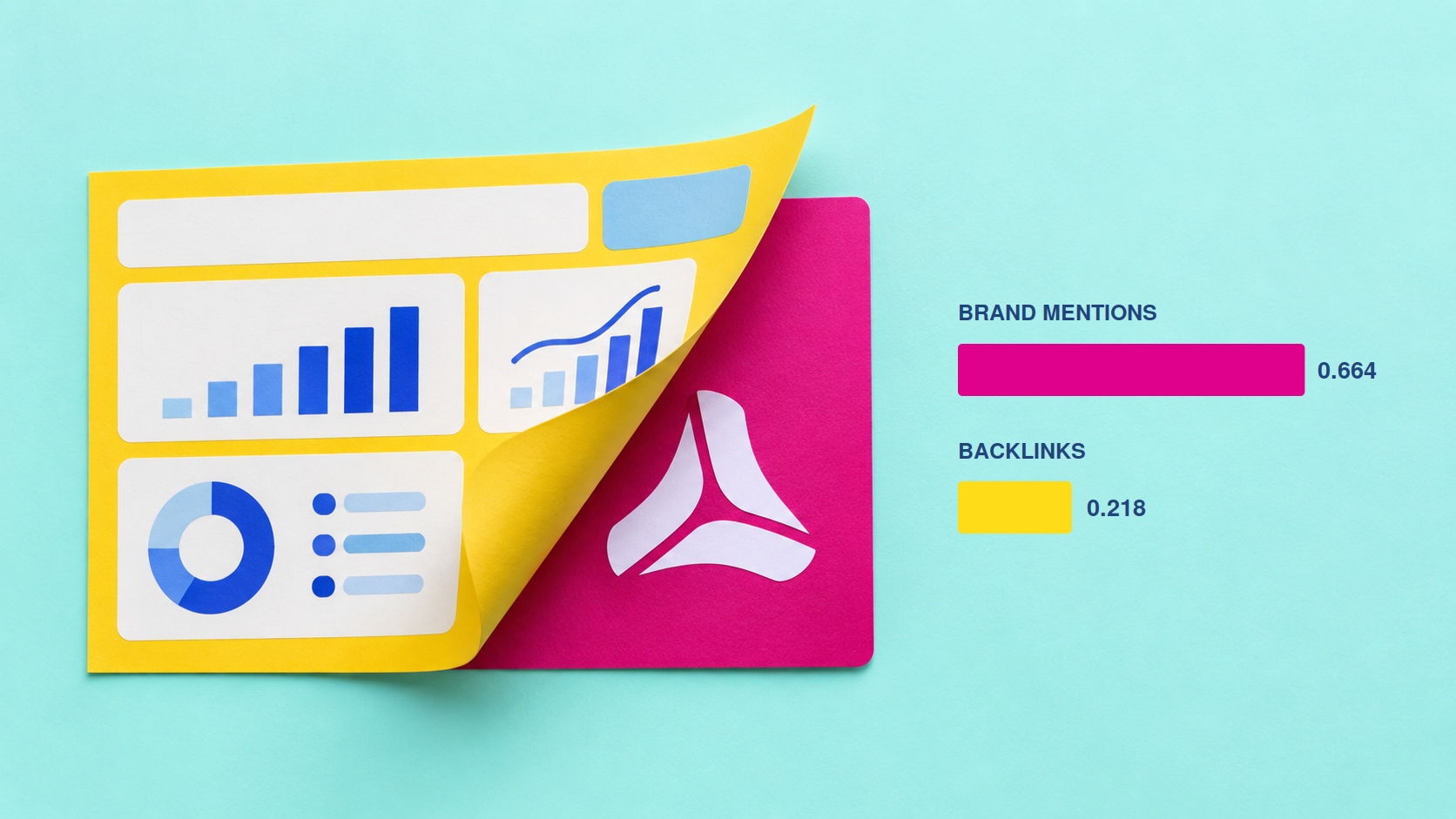
A brand doesn't become citable "from its own site." Branded search volume is the single best predictor of AI citations, with a correlation of 0.334 (AirOps, 2025). The more your brand is discussed elsewhere, the more AI treats it as a reference. And Reddit is the #1 source across all AI platforms combined, with roughly 40% of citations (Discovered Labs, 2025).
The three authority sources LLMs consult first
All platforms have their preferences, but three pillars come up everywhere.
- Wikipedia — ChatGPT cites Wikipedia in 47.9% of its top 10 sources (5W Public Relations, 2026). Without a Wikipedia page, your brand starts at a structural disadvantage on ChatGPT and Claude.
- Reddit and UGC — Perplexity favors Reddit at 46.7%, and content less than 30 days old is cited 3.2x more often. Presence on the right subreddits, vertical forums, and review platforms (Trustpilot, G2, Capterra) matters as much as SEO.
- Specialized media and barometers — releases picked up by business press (Trends, L'Echo, MM.be, ITdaily), citations in industry barometers and third-party studies. These are authority signals LLMs extract directly.
Our field observation. Across the 27 audited brands, 15 had no Wikipedia page, 22 had never been mentioned on Reddit, and 19 had no press releases indexed in the past 12 months. Combine those three authority gaps and the brand is almost mathematically invisible to LLMs.
The fix
Build a Digital PR plan designed for LLMs, not just for journalists. Three priorities: systematically target the 10 media outlets and 10 UGC platforms LLMs consult in your vertical, produce original data (studies, barometers, surveys) that will be naturally picked up, and structure a Wikipedia presence the right way (notability, verifiable third-party sources).
For the method and our Digital PR campaign benchmarks designed for GEO, see our deep dive The role of Digital PR in GEO and our case study +42% AI mentions in 3 months: the IDO method in action.
Mistake #5 — Tracking nothing
Without monitoring, no steering. The AirOps 2025 study shows that only 30% of brands cited by an AI stay visible from one run to the next (AirOps, 2025). In other words, two out of three brands disappear and reappear in AI responses from one week to the next. Without monthly tracking of the right queries, the brand flies blind and always corrects too late.
What brands measure (badly) and what they should measure
Most marketing teams keep looking at Search Console and GA4 the way they did before 2024. That's not enough. GEO requires three new indicators.
- Share of Model — the share of times your brand is cited or mentioned by LLMs (ChatGPT, Perplexity, AI Overviews, Claude, Gemini) across 50 to 200 strategic queries in your category. It's the AI equivalent of "share of voice."
- Explicit citation rate — the frequency at which your URLs appear as a cited source on platforms that expose their sources (Perplexity, AI Overviews, ChatGPT Search).
- Qualified AI-referred traffic — GA4 visits coming from referrers
chatgpt.com,perplexity.ai,claude.ai,copilot.microsoft.com, and their conversion rate. According to Search Engine Land, ChatGPT traffic converts at 15.9% versus 1.76% for Google organic.
The fix
Put a simple monthly cadence in place, even a manual one at first. Define 50 to 200 priority queries tied to your brand, your category, and your use cases. Test each query across the 4-5 major platforms. Log in a spreadsheet the brands mentioned, sources cited, and your brand's position in the answer. At scale, move to a dedicated tool (Profound, Otterly, AthenaHQ, Peec.ai, or a custom tracker).
For the method, the tools, and the detailed KPIs, see our complete guide to AI citation monitoring and our deep dive GEO ROI: how to measure return on investment in 2026.
How to avoid these 5 mistakes in 2026?
A serious GEO strategy tackles the 5 mistakes in parallel, not sequentially. According to our internal PingPrime data across 27 audits in 2025-2026, brands that address all 5 levers at once see results in 8 to 12 weeks, versus 6-9 months for those tackling them one after another. The logic is cumulative: no extraction without structured content, no authority without evidence, no steering without monitoring.
The 90-day action plan
Here's the sequence we recommend to our clients to neutralize all 5 mistakes in a single quarter.
- Weeks 1-2 — Complete GEO audit: robots.txt, editorial structure, level of evidence, external presence, existing monitoring. See our GEO audit method.
- Weeks 2-4 — Quick technical fixes: robots.txt, Schema.org markup, date freshness, Author and Organization markup.
- Weeks 3-8 — Rewriting of the 20-30 priority pages in Answer-First format, with stats library and citations injected.
- Weeks 4-12 — Launch Digital PR, Wikipedia, Reddit (depending on notability). Production of at least one piece of original data (study, barometer, survey).
- Weeks 1-12 (ongoing) — Set up monthly monitoring on 50-200 priority queries.
If you want to get started on your own, our tools page bundles several free resources to audit your AI visibility. If you'd rather be supported by our team, we offer a structured 12-week GEO sprint: see our engagement offer.
FAQ on GEO mistakes
What's the most costly GEO mistake in 2026?
The unintentional blocking of AI crawlers via robots.txt. A brand can invest hundreds of hours in content, E-E-A-T, and Digital PR — if GPTBot or PerplexityBot is blocked, it's all wasted. According to Bain & Company, 80% of users already rely on AI summaries for 40% of their searches (Bain, 2025) — one hour of robots.txt audit can unlock massive visibility.
How long does it take to fix these 5 mistakes?
Between 8 and 12 weeks for the essential fixes, 6 months for stable, measurable results. Technical fixes (robots.txt, Schema, freshness) take 2 weeks. Answer-First editorial rewriting takes 4 to 8 weeks depending on scope. External authority is the slowest to build: count 3-6 months for clear effects, especially on Wikipedia and media.
Should you fix everything in-house or get external support?
It depends on the SEO team's maturity and your GEO ambition. For a site with fewer than 50 key pages and an SEO team in place, in-house works with a solid framework. For larger, multilingual sites, or highly competitive verticals (B2B Tech 82% AIO, Healthcare 88%, according to BrightEdge, 2025), a sprint with a specialized team dramatically shortens the timeline and avoids costly mistakes.
Is GEO relevant for Belgian SMEs?
Yes, and especially so. 67% of Belgians already use generative AI and 36% have made a purchase decision on an AI recommendation (Semactic & PingPrime study, November 2025). An SME well positioned in LLMs can leapfrog much larger but less extractable competitors. For the details, see our GEO guide for SMEs.
Conclusion: from diagnosis to action
The 5 mistakes detailed here are not expert subtleties — they're the foundations. Until they're fixed, no advanced GEO tactic will produce lasting results. Across the 27 sites audited by PingPrime in 2025-2026, 89% committed at least 3 of these 5 mistakes, and nearly all saw their AI visibility improve in less than 12 weeks after the fixes.
The right reflex in 2026: audit in a few hours, prioritize the quick fixes (robots.txt, Schema, adding stats), then move on to Answer-First rewriting and monitoring. To go further, see our State of GEO in 2026 and our case studies page. To discuss an audit or a 12-week GEO sprint with our team: contact PingPrime.


.svg)
